Kuchina auto-clean chimneys are widely installed across Indian households because they eliminate frequent manual filter washing. They rely on an internal thermal heating coil wrapped around the blower casing. When you press the auto-clean button, the heating strip warms up to melt grease and grime, which flows into an oil collector cup. When this heating circuit fails, oil thickens on the fan wheel, creating heavy motor strain, burning smell, and severe suction drop. Our technicians specialize in thermal auto-clean diagnostics, heating strip replacement, PCB sensor recalibration, and oil drainage unblocking.
How Auto-Clean Works & Common Faults
Thermal auto-clean operates on a timed cycle (typically 10 to 15 minutes). The PCB sends electrical current to the heater element, warming the blower chamber to around 70°C–80°C. Common symptoms of failure include the auto-clean light flashing continuously without heat, grease smoking inside the canopy during cleaning, oil overflowing around the sides instead of dripping into the tray, and the fan refusing to restart after the cycle completes. Technicians test element continuity with a multimeter, check the thermal cutoff thermostat, and verify the main relay on the control board.
Parts & Pricing: Auto-Clean Chimneys
| Part Name |
Purpose |
Common Fault |
Indicative Price (₹ INR) |
Cost Factors |
| Thermal Heating Element |
Melts grease off blower casing during cleaning |
Burned coil, no heating when activated |
₹850 – ₹1,450 |
Blower diameter, wattage rating |
| Oil Collector Tray (SS / Plastic) |
Catches liquefied oil runoff |
Cracked plastic, loose mounting clips |
₹350 – ₹650 |
Model compatibility, material |
| Auto-Clean Control PCB |
Controls timed heating & relay switching |
Error beeping, continuous heating, failure to start |
₹1,200 – ₹2,100 |
Touch vs gesture board version |
| Thermal Cutoff Sensor |
Prevents motor housing from overheating |
Tripping prematurely, shutting power off |
₹300 – ₹550 |
Temperature tolerance threshold |
Common Problems with Auto-Clean Chimneys
- Auto-Clean Heating Fails: Customer notices no heat when auto-clean button is pressed. Possible reason is an open-circuit heating coil or faulty PCB relay. Technician tests element resistance and replaces defective thermal strip.
- Oil Leaking Past Collector Tray: Customer notices oil dripping from canopy corners onto stove. Reason is clogged oil channel or misaligned tray. Technician clears solid carbon sludge with industrial degreaser and realigns collection channel.
- Chimney Shakes During Auto-Clean: Customer notices heavy vibration during cleaning cycle. Reason is uneven oil accumulation on blower fan blades. Technician removes blower assembly and performs chemical immersion cleaning.
- Burning Smell During Cleaning: Customer smells electrical burning. Reason is overheating sensor failure or wire insulation touching the hot casing. Customer should turn off power immediately and request technician inspection.
Frequently Asked Questions: Auto-Clean Chimneys
How often should I run the auto-clean function on my Kuchina chimney?
For normal Indian cooking with regular tadka and shallow frying, run the auto-clean cycle once every 10 to 15 days. For deep frying, running it once weekly prevents grease from hardening onto the motor casing.
Why does my auto-clean chimney beep and stop midway?
Error beeping during auto-clean usually points to a thermal sensor alert, a stuck relay, or low voltage supply. The controller halts heating as a safety safeguard to prevent motor overheating.
Can a burned auto-clean coil damage the chimney motor?
If a shorted heating strip trips the main PCB without blowing an internal fuse, it can cause voltage spikes to the motor windings. Prompt diagnosis prevents collateral damage to the motor.
What is the technician inspection fee for auto-clean chimneys?
Our standard doorstep visiting charge is ₹299–₹399. The technician inspects the heating strip, blower, and PCB, and gives you a transparent quote before any replacement is started.
Kuchina filterless kitchen chimneys feature an unobstructed suction path that draws fumes directly into an internal high-speed sealed motor and centrifugal fan. Because there are no mesh or baffle filters to impede airflow, these models deliver high suction power (1200–1500 m³/hr). However, because smoke flows directly into the housing, heavy oil droplets gradually coat the impeller fan blades over 8 to 12 months. This causes fan imbalance, humming noises, and reduced air velocity. Our doorstep technicians specialize in filterless chimney motor balancing, impeller chemical degreasing, and motion-sensor control fixes.
How Filterless Chimneys Work & Common Faults
The motor housing is sealed to prevent grease entering electrical coils, while aerodynamic baffle slots centrifuge oil into an integrated drainage channel. Common problems include gradual suction loss as thick grease glues dust onto impeller vanes, loud roaring sounds from bearing wear, and oil seeping around duct collar joints. Technicians measure air suction at the intake grill with an anemometer, check motor shaft axial play, and clean out the internal centrifugal collector ring.
Parts & Pricing: Filterless Chimneys
| Part Name |
Purpose |
Common Fault |
Indicative Price (₹ INR) |
Cost Factors |
| Centrifugal Blower Fan (Impeller) |
Generates high suction airflow |
Blade damage, heavy grease encrustation, wobbling |
₹750 – ₹1,350 |
Impeller diameter, metal vs composite |
| Sealed Copper Motor (180W–230W) |
Drives high-RPM suction wheel |
Winding burnout, bearing seizure, loud humming |
₹1,800 – ₹3,400 |
Motor wattage, thermal class rating |
| Motion Gesture Sensor PCB |
Touch-free hand wave speed control |
Unresponsive to hand waving, erratic switching |
₹950 – ₹1,650 |
Sensor optical module version |
| Exhaust Duct Pipe (Aluminum/PVC) |
Channels smoke outside kitchen |
Torn flexible pipe, backdraft flap stuck |
₹450 – ₹850 |
Diameter (6-inch), length, material |
Common Problems with Filterless Chimneys
- Suction Dropping Over Time: Smoke lingers in the kitchen even at speed 3. Reason is grease coating the internal blower curvature and narrowing exhaust duct. Technician performs deep chemical clean of blower and clears duct pipe.
- Loud Humming or Roaring Noise: Chimney roars loudly when switched on. Reason is worn motor ball bearings or unbalanced fan blade loaded with uneven grease. Technician inspects bearings and balances impeller.
- Gesture Wave Control Not Responding: Waving hand does not turn chimney on or change speed. Reason is greasy film on optical sensor glass or misaligned infrared sensor board. Technician cleans optic lens and tests board voltages.
- Oil Leaking from Exhaust Pipe: Oil runs down the exterior wall or drops from pipe joint. Reason is poor duct slope or missing pipe seal. Technician reseals pipe joint with aluminum duct tape and creates proper outward slope.
Frequently Asked Questions: Filterless Chimneys
Do filterless chimneys truly need zero maintenance?
No. While you do not need to clean filters every week, the internal fan and motor housing accumulate sticky grease and require professional deep cleaning every 8 to 12 months for Indian cooking.
Why does my filterless chimney make a whistling noise?
Whistling usually indicates an airflow restriction in the exhaust duct pipe, a bent bend, or a jammed backdraft shutter at the exterior wall.
Can motion gesture control be repaired if it stops working?
Yes. In most cases, cleaning the sensor window or replacing the small gesture optical sensor board restores full touch-free hand wave functionality.
How much does motor replacement cost for a filterless model?
Replacement sealed copper motors range between ₹1,800 and ₹3,400 depending on wattage (180W–230W) and mounting brackets, plus technician visiting and installation charges.
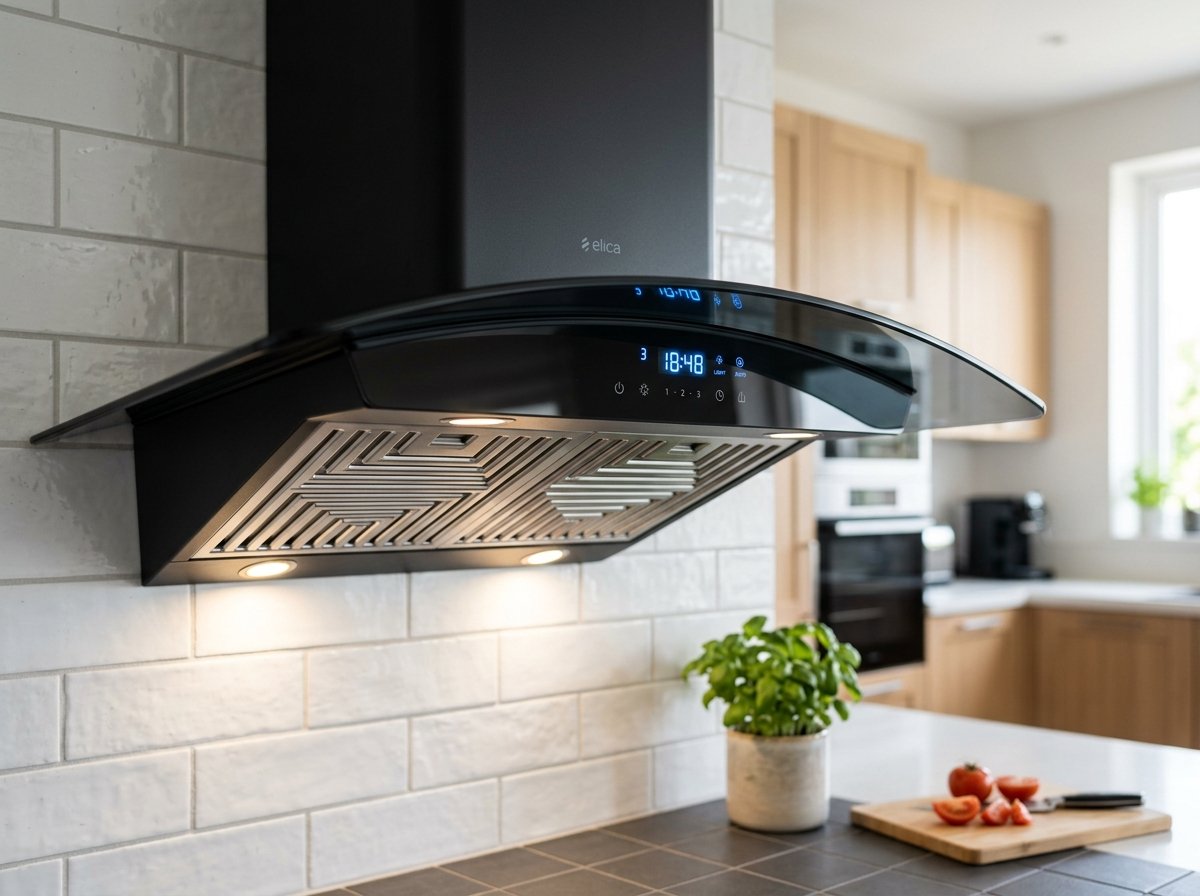
Curved-glass kitchen chimneys combine a central stainless steel motor hood with an elegant curved tempered glass canopy that guides smoke plumes into the suction intake. These are among the most popular wall-mounted chimneys in modular Indian kitchens. Common issues include vibration rattles between the glass wing and metal frame, oil creeping underneath the glass rim, failure of integrated LED downlights, and touch controls becoming unresponsive due to cooking steam. Our service technicians carry glass vibration dampeners, replacement LED driver units, touch sensor ribbon cables, and motor shock absorbers.
How Curved-Glass Chimneys Work & Common Faults
The wide curved glass wing widens the capture zone across 3-burner and 4-burner cooking stoves. Air travels through baffle filters or auto-clean blowers. Faults frequently stem from improper wall mounting (causing vibration on higher speeds), moisture condensation shorting the front touch panel, or burnt-out LED spot modules. Technicians check the wall mounting brackets, test touch sensor continuity, and verify 12V DC power from the LED driver transformer.
Parts & Pricing: Curved-Glass Chimneys
| Part Name |
Purpose |
Common Fault |
Indicative Price (₹ INR) |
Cost Factors |
| LED Downlight Module (1.5W–3W) |
Illuminates the cooking stove surface |
Flickering light, diode failure, no illumination |
₹250 – ₹450 |
Warm vs cool white, connector type |
| Touch Sensor Panel Strip |
Controls power, light, and 3-speed suction |
Buttons unresponsive, phantom speed switching |
₹850 – ₹1,550 |
Number of speeds, glass interface type |
| Glass Mounting Rubber Dampers |
Cushions glass canopy against steel housing |
Hardened or missing rubber causing rattling |
₹150 – ₹300 |
Gasket thickness and model kit |
| Motor Run Capacitor (4µF–6µF) |
Provides initial motor starting torque |
Motor hums but does not spin unless pushed |
₹200 – ₹400 |
Microfarad rating, voltage tolerance |
Common Problems with Curved-Glass Chimneys
- Canopy Rattles at Speed 2 or 3: Annoying metallic buzzing noise when chimney runs. Reason is degraded rubber buffer between glass and metal hood, or loose wall expansion screws. Technician tightens anchor brackets and fits fresh anti-vibration rubber gaskets.
- Both LED Lights Not Working: Stove surface is dark. Reason is failed 12V LED driver transformer on the main PCB or blown LED chips. Technician tests transformer output and replaces driver unit.
- Touch Buttons Beep But Motor Doesn't Run: Panel accepts touch input but fan stays idle. Reason is blown starting capacitor or stuck motor relay. Technician checks capacitor charge and tests motor windings.
Frequently Asked Questions: Curved-Glass Chimneys
Can cracked curved glass on a kitchen chimney be replaced?
Yes, tempered curved glass can be replaced if the specific dimensions match the frame. However, availability depends on model age; a technician checks dimensions and mounting clip positions during inspection.
Why did the touch buttons become sluggish or unresponsive?
Cooking steam and airborne oil often seep behind the glass panel, creating capacitive interference. Cleaning the internal sensor contacts usually restores normal sensitivity.
How do you stop glass canopy vibration?
Technicians install heat-resistant silicone dampers and re-anchor wall mounting brackets into solid masonry to absorb motor vibration.
Straight-line and box chimneys fit flush under overhead kitchen cabinets or within compact modular cabinetry layouts. They typically feature mechanical push-button switches or sleek linear touch ribbons with dual baffle filters. Because they are often fitted into tight overhead cabinetry recesses, common faults involve duct pipe pinching inside narrow soffit openings, heat trapped around the motor casing, and push buttons getting physically jammed by cooking grease. Our technicians handle duct realignment, switch-pack replacements, and compact blower servicing.
How Box Chimneys Work & Common Faults
Box chimneys draw air directly through a flat horizontal intake grille. Because cabinet enclosures restrict ambient heat dissipation, older units can suffer motor thermal cutout trips during long cooking sessions. Mechanically, push-button switches collect grease over years of use, causing buttons to stick or fail to lock on high speed. Technicians inspect internal cabinet clearances, measure motor temperature rise, and service or replace worn switch clusters.
Parts & Pricing: Straight & Box Chimneys
| Part Name |
Purpose |
Common Fault |
Indicative Price (₹ INR) |
Cost Factors |
| Mechanical 3-Speed Push Switch Pack |
Selects speeds 1, 2, 3 and light power |
Buttons stick, spring failure, no electrical contact |
₹350 – ₹650 |
Switch pin count, bracket design |
| Compact Blower Housing |
Houses fan and routes air upwards |
Housing cracks, grease seepage from joints |
₹600 – ₹1,100 |
Frame dimensions, outlet diameter |
| Stainless Steel Baffle Filter Set |
Traps grease droplets from cooking fumes |
Bent edges, broken filter latch, heavy grease crust |
₹450 – ₹850 |
Filter dimensions (e.g., 60cm vs 90cm kit) |
Common Problems with Straight & Box Chimneys
- Push Buttons Stuck Down: Pressing speed 2 causes the button to stay jammed inside the casing. Reason is sticky oil coating the internal spring mechanism. Technician cleans switch assembly with contact cleaner or installs a new switch cluster.
- Chimney Shuts Off After 20 Minutes: Unit runs normally then stops unexpectedly, restarting only after cooling down. Reason is motor overheating caused by poor cabinet ventilation or failing thermal protection switch. Technician improves ventilation and inspects motor coils.
Frequently Asked Questions: Box Chimneys
Can push buttons on a box chimney be replaced with a touch panel?
Generally no. Push-button models use direct AC line switching, whereas touch panels require a low-voltage DC motherboard and transformer. Replacing the mechanical switch pack is the reliable, cost-effective solution.
Why does smoke escape from the sides of my under-cabinet chimney?
This usually indicates a compressed or kinked flexible duct pipe inside the overhead cabinet, creating backpressure that forces smoke to escape around the canopy seams.
Inclined and angular chimneys mount at an angle against the kitchen wall, providing clear headroom so cooks never bump their heads over steaming pots. Many premium models feature motorized opening glass panels that tilt upward automatically when power is switched on. Because they incorporate motorized door actuators and sophisticated control motherboards, typical repair issues include motorized panel jamming, limit switch failure, sensor synchronization glitches, and dual-suction port clogs. Our technicians are trained in motorized actuator diagnostics and angular chimney geometry repairs.
How Angular Chimneys Work & Common Faults
When turned on, a small stepper or synchronous actuator motor opens the front tempered glass visor. This directs rising smoke plumes directly into high-velocity perimeter suction slots. If the visor limit switch fails, the panel may grind, shudder, or remain stuck closed while the blower motor runs. Technicians test panel actuator voltages, lubricate drive linkages, and check perimeter suction velocity.
Parts & Pricing: Angular & Inclined Chimneys
| Part Name |
Purpose |
Common Fault |
Indicative Price (₹ INR) |
Cost Factors |
| Motorized Door Actuator Motor |
Opens and closes front glass panel |
Stripped gear teeth, motor stalling, panel stuck |
₹850 – ₹1,650 |
Torque rating, gear mechanism type |
| Panel Position Limit Switch |
Detects open/closed positions of glass visor |
Panel keeps grinding at end of travel |
₹250 – ₹450 |
Microswitch vs magnetic reed sensor |
| Perimeter Suction Filter Grille |
Catches grease along outer edges |
Clogged grease slots, oil dripping onto counter |
₹550 – ₹950 |
Stainless steel finish, dimensions |
Common Problems with Angular Chimneys
- Glass Panel Will Not Open: Blower turns on but front visor stays shut, blocking smoke from entering. Reason is a faulty actuator motor, broken drive cog, or bad actuator relay on the PCB. Technician replaces actuator or repairs drive linkage.
- Grinding Noise When Opening: Loud clicking or grinding when panel opens. Reason is stripped nylon gears in the actuator caused by forced manual opening. Technician replaces the actuator gear motor.
Frequently Asked Questions: Angular Chimneys
Can an inclined chimney operate if the motorized glass stays closed?
Operating with the visor shut severely restricts airflow, leading to zero smoke extraction and motor overheating. The actuator must be repaired before normal use.
Are parts for inclined chimneys easily available?
Common electrical parts like capacitors, LED drivers, and standard motors are widely stocked. Specific actuator brackets and curved visors are sourced based on model inspection.
Traditional baffle filter kitchen chimneys use patented curved stainless-steel panels that force incoming greasy air to rapidly change direction. Through inertia, heavy grease droplets separate from air and settle into filter grooves while clean air exhausts outside. While durable and effective for heavy spices and deep frying, neglecting filter cleaning allows grease to solidify like cement, clogging airflow and causing grease to drip back into cookware. Our service includes chemical immersion filter restoration, latch repair, and motor maintenance.
How Baffle Filters Work & Common Faults
Baffle filters need periodic cleaning every 2 to 3 weeks in Indian homes. If washed with harsh caustic soda, filter edges can warp, corrode, or lose their spring latch tension, causing filters to rattle or fall out during cooking. Technicians repair worn spring clips, straighten warped frames, and perform full motor lubrication.
Parts & Pricing: Baffle Filter Chimneys
| Part Name |
Purpose |
Common Fault |
Indicative Price (₹ INR) |
Cost Factors |
| SS Baffle Filter Plate (Per Piece) |
Separates oil droplets via curved air channels |
Bent frame, broken handle latch, severe rust |
₹350 – ₹650 |
Stainless grade (SS 304 vs 202), size |
| Spring Lock & Latch Kit |
Locks filter firmly into hood frame |
Broken release latch, loose filter falling |
₹150 – ₹280 |
Latch mechanism type |
| Oil Collector Groove Seal |
Prevents oil escaping along hood bottom |
Hardened silicone, oil dripping on tiles |
₹200 – ₹350 |
Silicone gasket length |
Common Problems with Baffle Filter Chimneys
- Grease Dripping from Filter Edges: Oil drips down onto cooking pans during frying. Reason is saturated filter channels and hardened grease sludge. Solution is deep chemical degreasing of baffles and internal hood wiping.
- Severe Suction Loss: Chimney runs at high speed but smoke does not clear. Reason is air slots blocked with solidified grease. Washing filters in warm degreasing solution immediately restores airflow.
Frequently Asked Questions: Baffle Filters
Can baffle filters be cleaned in a dishwasher?
Yes, stainless steel baffle filters can be placed in a dishwasher on a hot cycle. However, filters with heavy baked-on grease benefit from soaking in warm water with mild degreaser first.
How long do stainless steel baffle filters last?
Quality stainless steel baffle filters last 5 to 8 years or more if cleaned gently without corrosive acids that ruin metal finishes.